BKMWM Newsletter · Oct./Nov. 2026
Rising Rates, Treasuries and Fall Tax Reminders: Oct./Nov. 2026 Newsletter
1) Rates Are Rising Fast: What It Means For You
What is happening
Interest rates have climbed quickly this fall. The 10-year Treasury yield, the benchmark behind mortgages and most long-term borrowing, closed at 5.24% on October 9, more than a full percentage point higher than a year ago. Here is what is happening, why it is happening, and what it means for you.
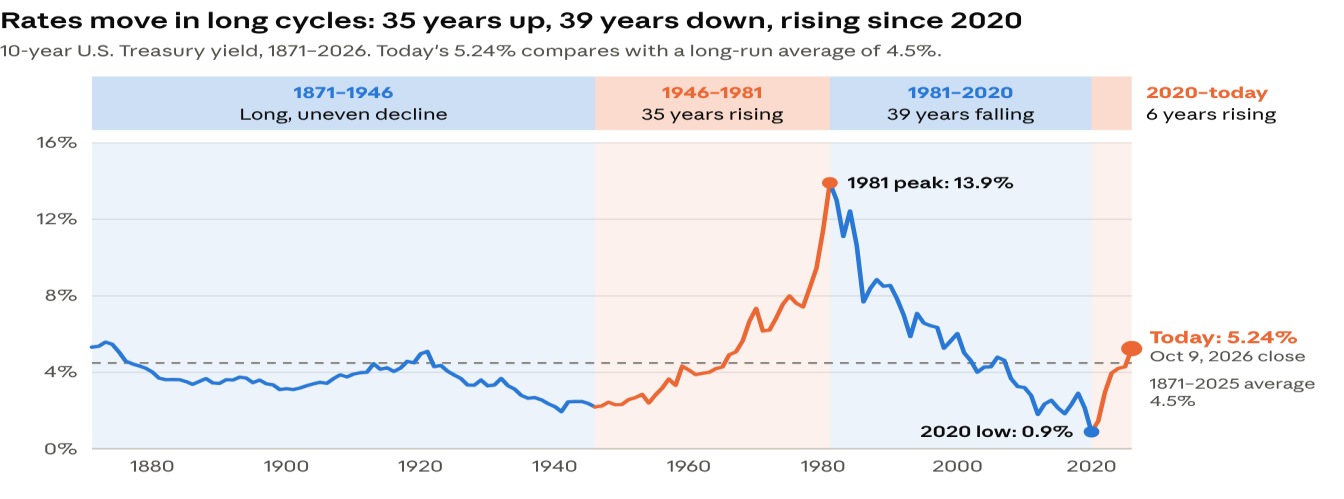
5.24% is a bit above the long-run average of about 4.5%. From 1967 through 2001, the 10-year averaged more than 5% every single year.1 The ultra-low rates of the 2010s were the exception, not the rule.
Everyone is borrowing
An interest rate is the price of borrowing money, and right now two of the world’s largest borrowers are in the market at once. Big Tech, once self-funded, now borrows heavily to build AI infrastructure. The largest cloud companies sold $121 billion of U.S. bonds in 2025, versus about $28 billion a year before.2 Even cash-rich Nvidia borrowed $25 billion in June.3
Washington is borrowing more, too. The national debt passed $40 trillion in August, this year’s deficit is expected near $2.1 trillion,4 and interest now costs more than defense.5 Deficits this large are usually reserved for recessions, not a growing economy with 4.2% unemployment. Left unchecked, that path is not sustainable, and lenders want higher rates to compensate.
What it means for you
Savers. Cash finally pays; roughly 3.8% to 4.4% can be earned in money funds, top savings accounts and CDs. After inflation and taxes, little is left, and those rates will fall if/when the Fed cuts.
Investors. Falling bond prices are usually temporary for bonds held to maturity, and starting yields are now the highest in more than two decades,6 offering real, after-inflation income. Higher rates raise the bar for stocks, especially fast-growing or heavily indebted companies. That argues for diversification, a check on AI-related concentration, and possibly rebalancing or tax-loss harvesting.
Borrowers and business owners. On a $500,000 mortgage, today’s rate costs about $4,400 more per year than last year’s. Hold on to low fixed-rate loans, pay down variable-rate debt, stress-test business cash flow, and talk with lenders early about debt coming due.
Watchful, and cautiously optimistic
The level of rates partly reflects a solid economy, and savers are being paid again. The speed is what we’re watching, because fast-rising rates tend to expose weak spots. The AI and data center build-out and private credit remain at the top of our list; several private credit managers are now exploring sales of struggling funds.
This is a good time to revisit your financial plan, your tolerance for risk, and your portfolio allocation. If you’d like to talk through what rising rates mean for you, please reach out to our team.
Sources
- Federal Reserve Bank of St. Louis (FRED): 10-Year Treasury constant maturity, monthly (GS10)
- Reuters via The Edge: hyperscaler bond issuance
- Bloomberg Law: Nvidia’s $25 billion bond sale
- Fox Business: CBO projects $2.1 trillion FY2026 deficit
- CRFB: $2.0 trillion deficit in first 11 months of FY2026
- Bloomberg Government: 10-year yield briefly hits highest since 2002, October 1, 2026
2) Treasuries: Safe Haven or Risk Asset?
U.S. Treasuries have long been viewed as the flagship safe harbor for investors, and their yield is often used as a proxy for the “risk-free” rate of return. But with rising interest rates, persistent inflation, and growing concern over U.S. debt, it’s worth taking a closer look at how Treasuries actually behave.
While we consider Treasuries a safe asset, there are two main risks:
- Credit risk: the risk that the U.S. defaults on its payments.
- Price risk: the risk that rising interest rates or inflation drive Treasury values down.
U.S. government debt is now above $40 trillion, and by most accounts the government has become less fiscally responsible. Concerns have mounted that the country’s finances are on an unsustainable path. While there’s no real risk it will be unable to make its payments anytime soon, longer-term worries persist. The U.S. no longer holds a top-tier credit rating from the major agencies, and investors are demanding higher interest rates to hold Treasuries. The rising cost of financing government debt has occurred while inflation remains persistent and corporate borrowing has increased.
Recent academic studies have also uncovered some less visible risks. One risk involves the relationship between stocks and bonds. Depending on investor expectations, there are periods when bonds move in the same direction as stocks and other periods when they move independently, or even in the opposite direction1. When Treasuries move in tandem with stocks, they add risk to a portfolio rather than offset risk. In periods like today, when rates are expected to rise and bonds are seen as riskier, investors tend to demand a higher return, which makes bonds riskier still.
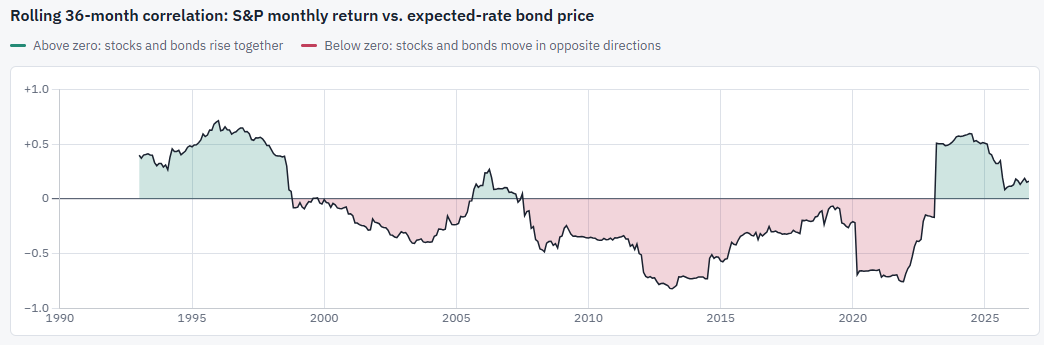
The chart above shows clear cycles. When investors expect bonds to outperform the risk-free rate, bonds tend to move in tandem with stocks and carry more risk, and vice versa.
Another risk lies in the type of inflation we’re experiencing2. “Good” inflation, driven by a growing economy and strong demand, has tended to be favorable for Treasuries. Inflation driven by supply constraints and stagflation is a different story. It makes Treasuries riskier, leads investors to demand higher yields, and puts downward pressure on both bond and stock prices. The current environment may be closer to the latter.
Taken together, this suggests that despite their higher yield, Treasuries may be entering an era in which they carry more risk than they have in recent decades.
Sources
- Leombroni, M., Pflueger, C., Sunderam, A. Risk and Return in Government Bonds (July 3, 2026). Available at SSRN: https://ssrn.com/abstract=7059018
- Cieslak, A., Pflueger, C. Inflation and Asset Returns (March, 2026). Available at SSRN: https://ssrn.com/abstract=4386592
3) The Prudent Person Rule
In February 2000, Bill Berrall, one of the foundational members of our team before BKM was created, wrote a newsletter about the “Prudent Man Rule.” At the time, technology stocks, along with almost any company ending in “.com,” were trading at unprecedented levels. Value stocks were out of favor, and speculation in growth stocks was rampant. Clients kept asking Bill, “Why don’t we own more tech stocks?” His answer was that, in his opinion, adding more technology exposure wasn’t prudent.
In the newsletter Bill referenced the 1830 Massachusetts court case that established the Prudent Man Rule. The rule requires money managers and fiduciaries to use sound judgment in choosing investments that preserve capital and generate reasonable income. In other words, they should act as a prudent person would. He put it plainly:
“with technology stocks trading at astronomical multiples of profits per share, it is just not prudent to recommend overweighting these issues at this time.”1
Shortly after that newsletter was published, the dot-com bubble burst. The Nasdaq Composite fell 78% from its peak in March 2000 to its low in October 2002. Exercising prudence helped steer clients away from holding too much in technology stocks.
As fiduciaries, we’re held to a standard of care that requires us to manage our clients’ portfolios with proper diversification for the level of risk we’ve agreed on. We try to avoid high exposure to any one sector or company. We’re here to help you navigate volatility and stay prudent.
Source
- Feb 2000 Morgan Stanley Dean Witter Newsletter - William J. Berrall
4) Fall Tax Reminders
Most tax-saving moves for 2026 must be made by December 31st, and this is the first full year of several changes from the 2025 tax law. Here are nine items to review with your BKM advisor before year-end. BKM’s website, bkmwm.com/bkm-newsletters, has more details and tips on each reminder.
1. Top off retirement contributions
Workplace plan deferrals must go through payroll by December 31st. The 2026 limit is $24,500, or $32,500 at age 50+ and $35,750 at ages 60–63. IRA contributions are limited to $7,500 ($8,600 at 50+) and can be made until April 15, 2027.
2. Harvest losses, or gains
Trades must be placed by December 31st. Realized losses offset gains plus up to $3,000 of ordinary income. Also check for year-end mutual fund distributions before buying.
3. Consider a partial Roth conversion
A conversion counts for 2026 only if completed by December 31st.
4. Plan charitable gifts around the new rules
Starting this year, people who take the standard deduction can deduct up to $1,000 of cash gifts ($2,000 joint), though gifts to donor-advised funds don’t qualify.
5. Take RMDs and consider QCDs
If you’re 73 or older, take your 2026 required minimum distribution by December 31st. If you’re 70½ or older, a qualified charitable distribution (QCD) sends up to $111,000 from your IRA directly to charity. It counts toward your RMD, stays out of taxable income, and sidesteps the new charitable limits.
6. Make the most of the new deductions
- State and local taxes (SALT): The cap is $40,400 for 2026.
- Seniors: Each person 65 or older gets an extra $6,000 deduction through 2028, phasing out above $75,000 of modified AGI ($150,000 joint).
- Tips, overtime, and car loan interest: These are newly deductible within limits, mainly helping working family members.
7. Use your benefits
Spend down health FSA balances by year-end. HSA contribution limits for 2026 are $4,400 self-only and $8,750 family. HSA contributions can be made until April 15, 2027, and do not need to be spent prior to year-end like an FSA.
8. Make annual gifts
You can give $19,000 per person ($38,000 per couple) in 2026 without using any of your lifetime exemption, which is now $15 million per person.
9. Check withholding and estimates
To avoid an underpayment penalty, pay at least 90% of this year’s tax or 100% of last year’s (110% if your 2025 AGI was over $150,000).
BKM Wealth Management can work as your tax advisor, but we are also happy to work with your outside accountant. Feel free to send us a copy of your 2025 tax return. We can run tax projections and provide planning analysis to help you reduce your tax burden. Contact your BKM advisor to get started.
Financial advisors whose mission is to positively impact lives.
BKM Wealth Management LLC is an Investment Advisor registered with the Securities and Exchange Commission. Reference to registration does not imply any particular level of qualification or skill. Information provided for educational purposes only.
BKM Wealth Management
20300 Water Tower Blvd, Suite 250
Brookfield, WI 53045
Tel: (262) 955-7150
Fax: (262) 955-7147
info@bkmwm.com